Stylish LED lighting in the shower area

Goodbye to ceiling lights: Watertight LED profiles make it possible to integrate the lighting technology seamlessly into the shower design. These creative solutions offer impressive functionality and aesthetic design that transform the shower into a visual highlight.

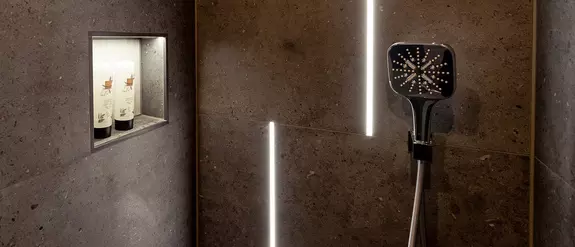
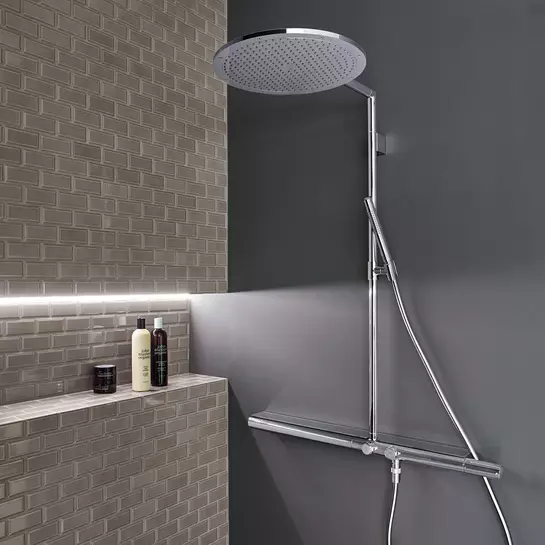
A dark grey-tiled shower with an illuminated wall niche and illuminated light profiles on the wall behind the fitting

Lights on, world off.

The modern bathroom has become much more than purely a functional space: It is regarded as a place of relaxation where we can escape the stresses of daily life and rejuvenate our physical and mental energy. Light plays a decisive role in this. A thoughtfully illuminated shower transforms the morning or evening routine into a personal spa experience – a moment of peace and relaxation in the midst of the hectic of everyday life. Safety is a primary concern, because wherever water could come into contact with electricity, strict adherence to applicable safety standards is imperative.

© Schlüter-Systems

First things first: Safety takes priority

Whatever the specific lighting installations or light colours chosen for your shower, there are strict safety regulations that must be observed during installation – and for very good reason. That is because the bathroom is a space exposed to high levels of humidity – and where electricity comes into contact with water, specific protective measures are required.

In Germany, DIN VDE 0100 Part 701 sets out the requirements that have to be taken into account when planning lighting in spaces with a bathtub or shower. It defines several protection areas (zones) for bathrooms and wet rooms that each require a different IP protection class. Electrical sources such as power supplies or transformers must always be installed away from these protection areas in order to eliminate any risk.

Protection zone 0

Inside areas of showers and bathtubs

Protection zone 0 comprises the interior of the bathtub or shower tray and also applies to a height of 10 cm on the walls in floor-level showers. Lighting fixtures installed in this zone are exposed to the greatest amounts of water, such as underwater lights in bathtubs or baseboard lights in showers. They must, therefore, also satisfy the most stringent requirements and have at least an IPX7 protection class against temporary immersion.

Protection zone 1

Wall surfaces above the shower tray and bathtub

Protection zone 1 is delimited by the vertical areas around the bathtub or shower tray. If there is no shower tray, it includes the vertical surfaces at a radius of 120 cm around the shower head in its resting position. In both cases, this limitation extends from the finished floor up to a height of 225 cm. Lights in this zone must comply with at least protection class IPX4 that means it is protected against splashes.

Protection zone 2

Connection areas around shower trays and bathtubs

Protection zone 2 adjoins protection zone 1 in a radius of 60 cm. The main concern in this area is from splashing water so an IPX4 protection class is again sufficient for lighting fixtures here. But if water jets or other harsher conditions can be expected – such as from massage jets or cleaning processes – electrical appliances must comply with protection class IPX5 at least – in protection zone 1 as well as in protection zone 2.

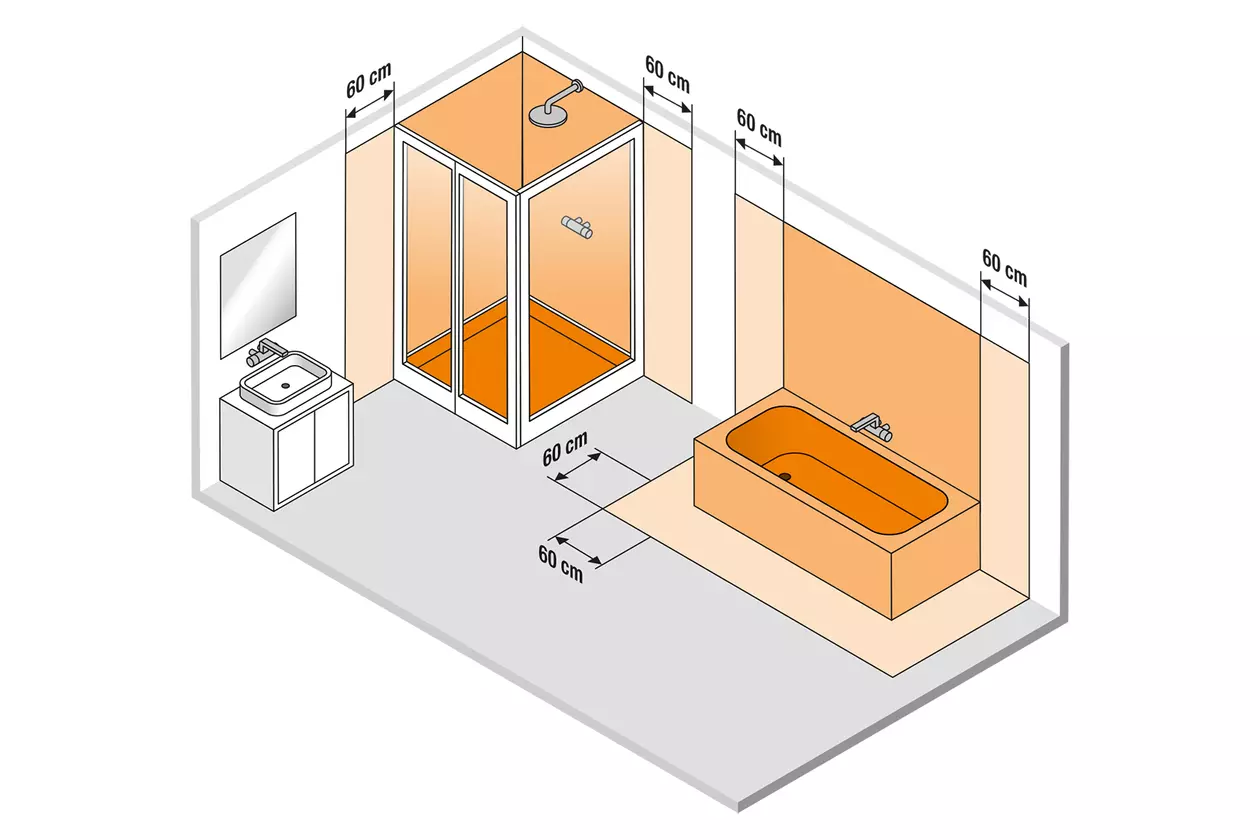
Illustration of the protection zones in the bathroom according to DIN VDE 0100 © Schlüter-System
The protection zones in the bathroom according to VDE 0100, with protection zone 0 shown in dark orange, protection zone 1 in orange and protection zone 2 in light orange.
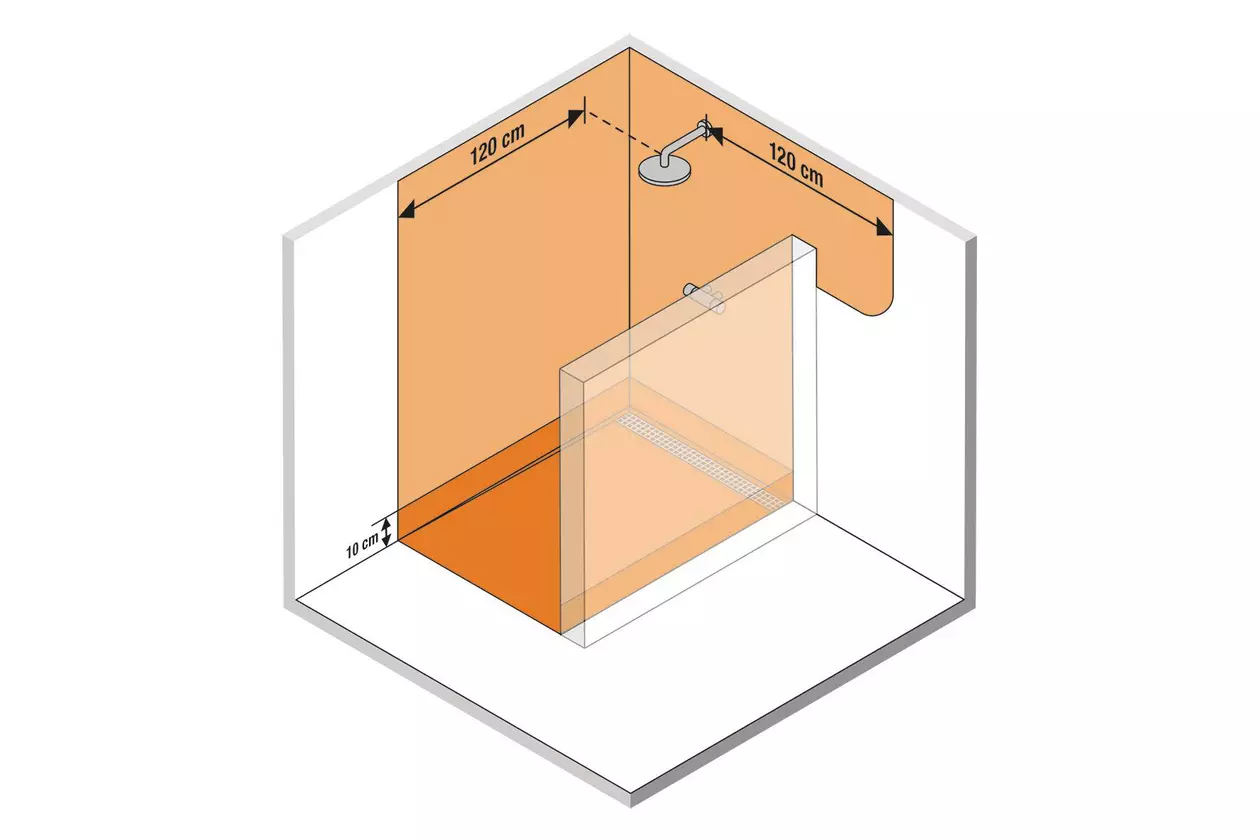
Illustration of the protection zones in the floor-level shower according to DIN VDE 0100 © Schlüter-System
In floor-level showers, protection zone 0 (dark orange) applies up to a wall height of 10 cm. Above that, protection zone 1 (orange) then applies.

What is the IP degree of protection?

The IP degree of protection denotes the suitability of electrical appliances and housings for particular environments by classifying their protection against contact, the ingress of foreign objects and also water. The degrees of protection are specified in accordance with the international standard DIN EN 60529 and are indicated by a combination of letters and numbers – such as IP44 or IP67.

IP stands for “International Protection” or also “Ingress Protection” where the first digit of the classification describes protection against foreign objects and contact while the second indicates protection against the ingress (i.e. penetration) of water.

Generally speaking, the higher the number, the better the protection. The IP44 rating, for example, indicates that the appliance is protected against foreign objects larger than 1 mm and against splashing water from any direction whereas a housing classified as IP67 is protected against dust and is fully protected against contact with, and temporary immersion in, water.

A wellness experience with that wow factor: Lighting options in the shower

How can you actually create the right mood lighting in a shower? What are the best places to use accent lighting? The good news is: There are virtually no limits to your creativity. Modern LED technology, such as Schlüter-LIPROTEC lighting profiles, provides an impressive variety of options for the aesthetically pleasing and seamless integration of architectural lighting into shower design. Instead of a single ceiling light, it is now possible to implement creative lighting concepts that offer the ultimate in functionality and aesthetics:

Illuminated niches

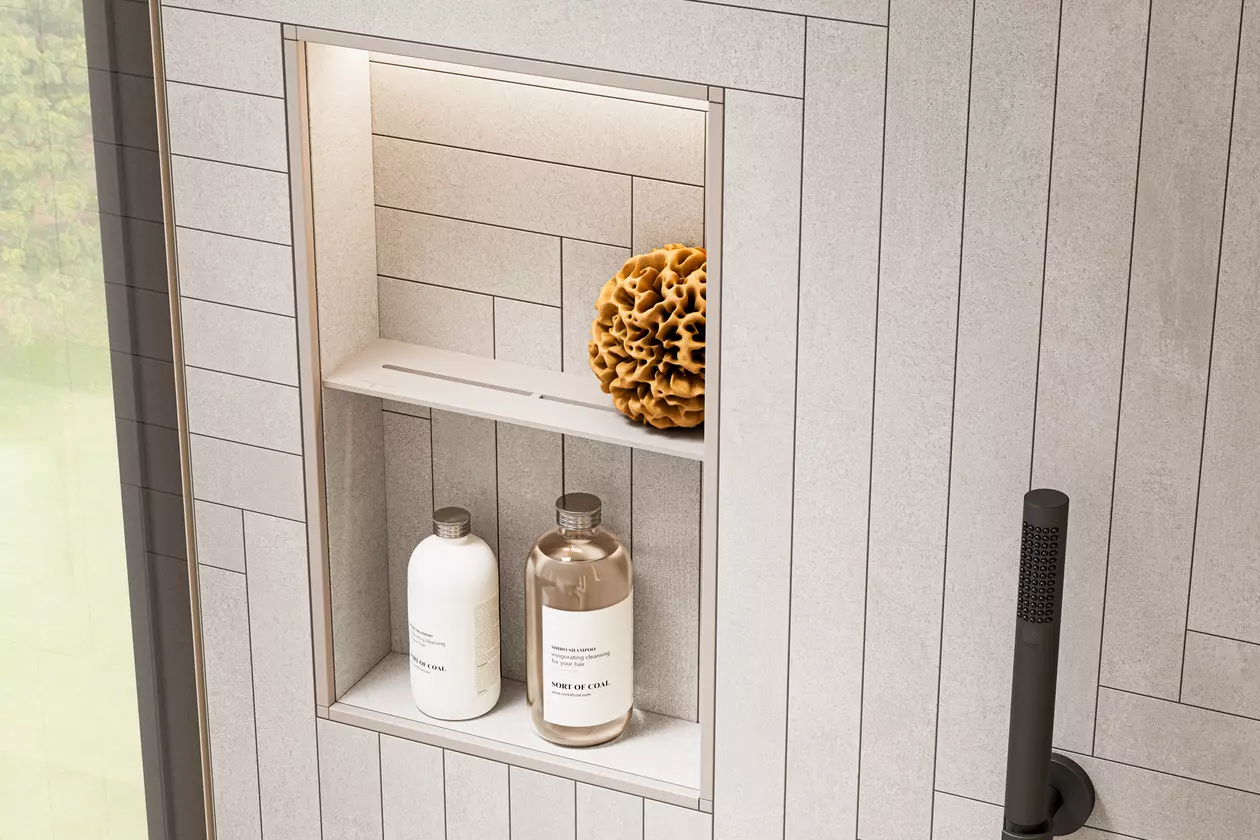
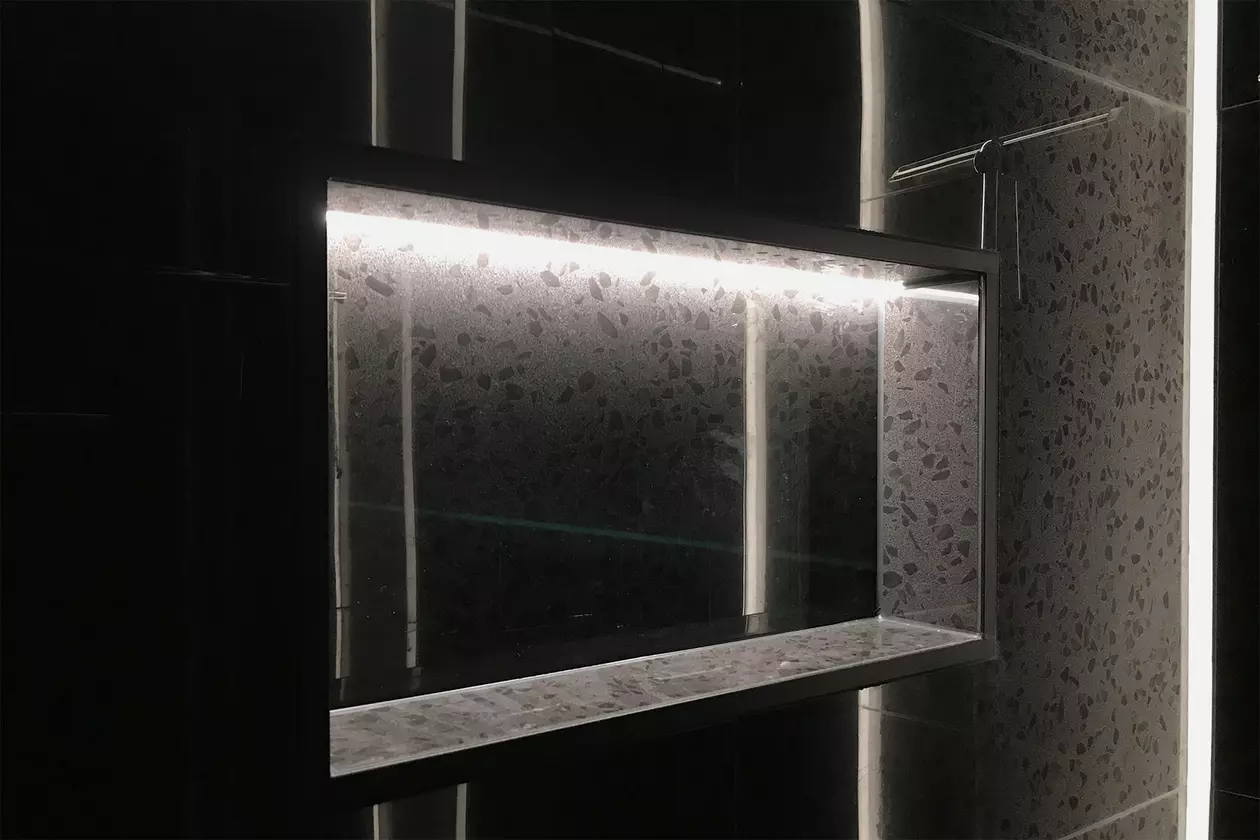
A black-tiled niche with lighting that throws light reflections onto the tiles © Schlueter-Systems

Wall niches in the shower are, above all, practical and attractive storage spaces that can be used to store personal care products in style without using up any extra space. The right lighting transforms them into a design statement: Indirect light adds a sense of depth to the space, giving it structure and dimension. The lighting profile is installed flush with the tile covering so none of the storage space itself is lost. Depending on personal preference, it can be installed along the front edge, in the centre or at the back of the niche, thus scattering more or less light into the space. Ready-made installation kits such as Schlüter-KERDI-BOARD-NLT make installation uncomplicated and safe.

Backlit wall-mounted installations

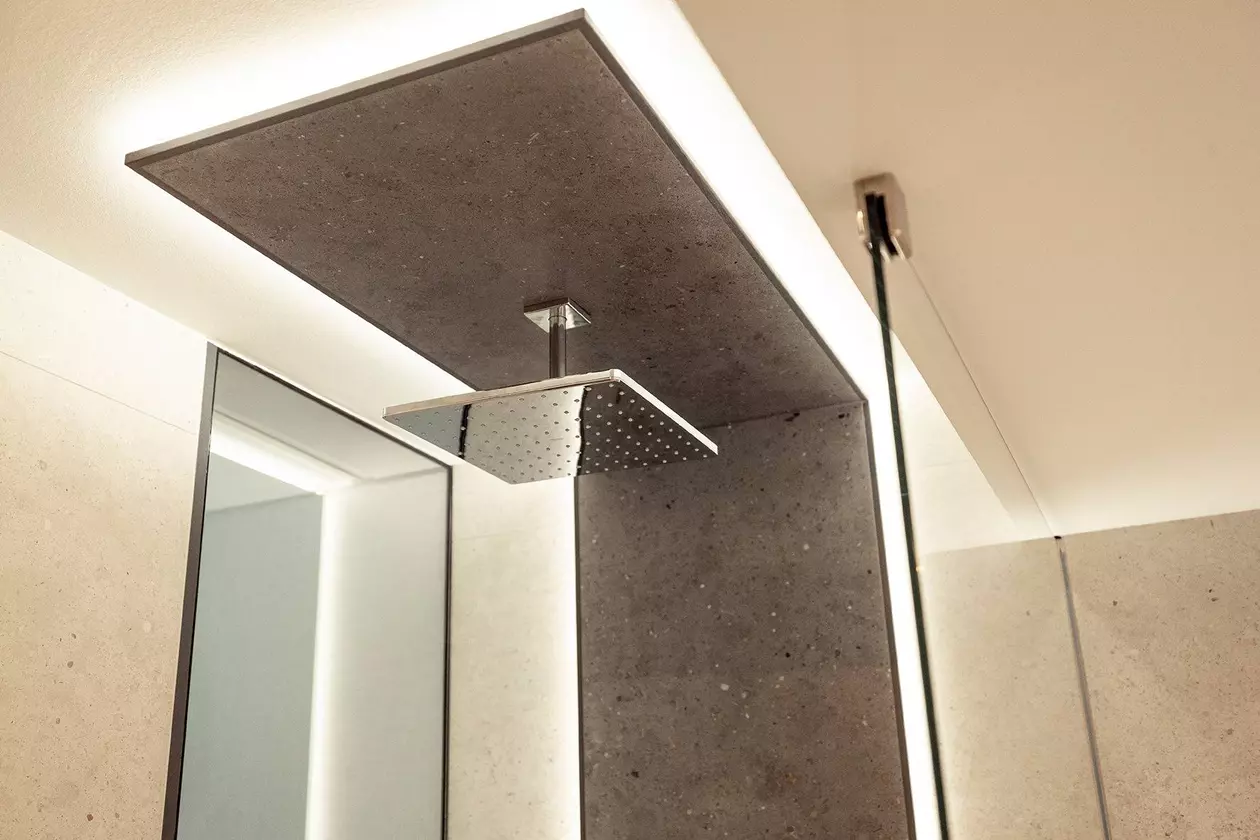
Ceiling and rear wall of a shower with a dark brown, backlit wall-mounted panel and a rain shower head © Schlueter-Systems

Whether vertical or horizontal, with direct or indirect lighting, bathed in white or coloured light: Wall-mounted installations are eye-catching, add depth and create a totally new experience of the space. The shower enclosure thus takes on a character all of its own: From subtle floating effects and soft edge designs to highlighting contrasts in brightness and colour that interact with the tile covering, practically anything is possible. Schlüter-LIPROTEC lighting profiles can be used to transform a shower stall into a multidimensional design surface and a wall panel into an evocative lighting feature.

Linear lights

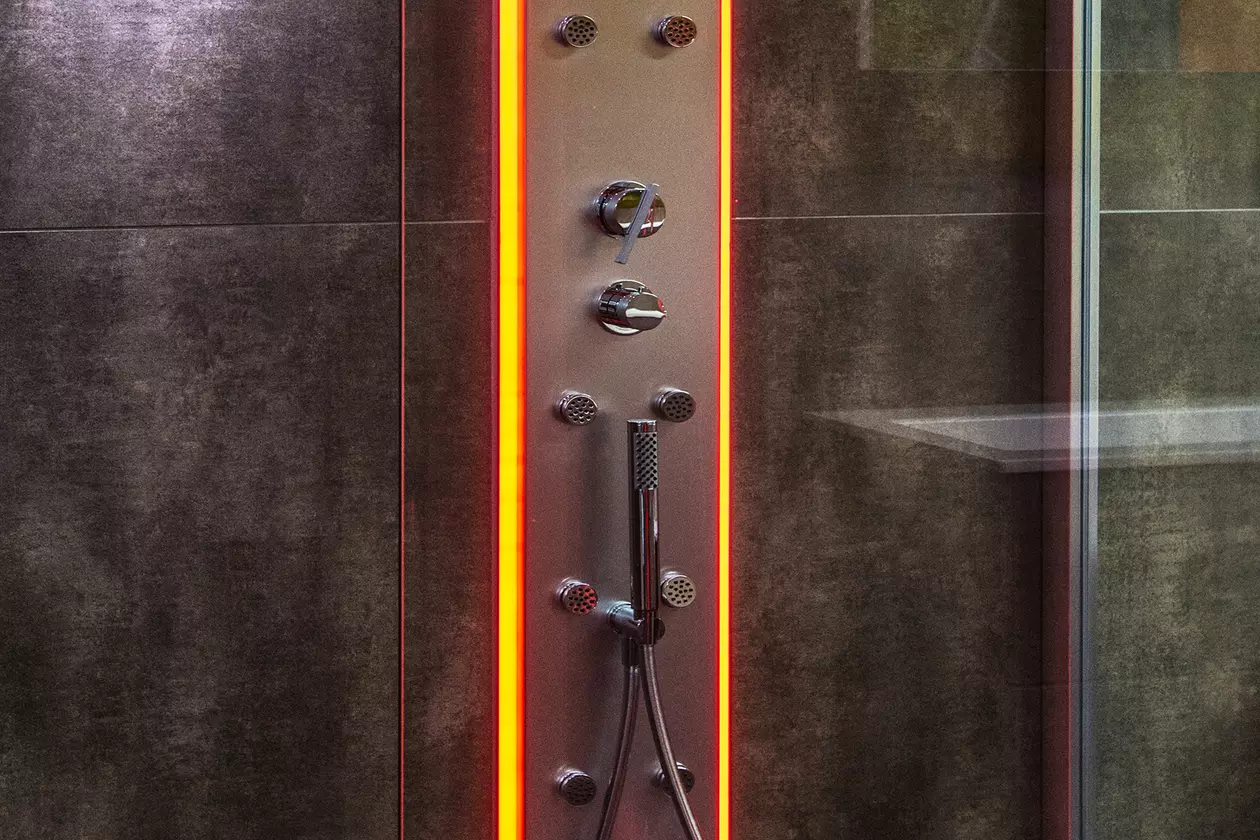
Shower enclosure with large dark tiles and bright orange vertical linear lights next to the shower mixer unit © Schlueter-Systems

Lighting strips recessed into walls, ceilings or corners add a modern and elegant appeal. At the same time, they catch the eye, enhance the architecture of the space and can even make it seem larger. They provide even, indirect lighting in the shower and create a relaxing, cosy ambience. Whether they are used to highlight the joints or placed freely across the tile covering, they also act as playful eye-catchers and provide glare-free lighting without casting shadows. Fully enclosed LED tubes and LED strips, such as Schlüter-LIPROTEC, designed specifically for use in damp rooms, meet the safety requirements and can be seamlessly integrated into the tile covering.

Skirting illumination

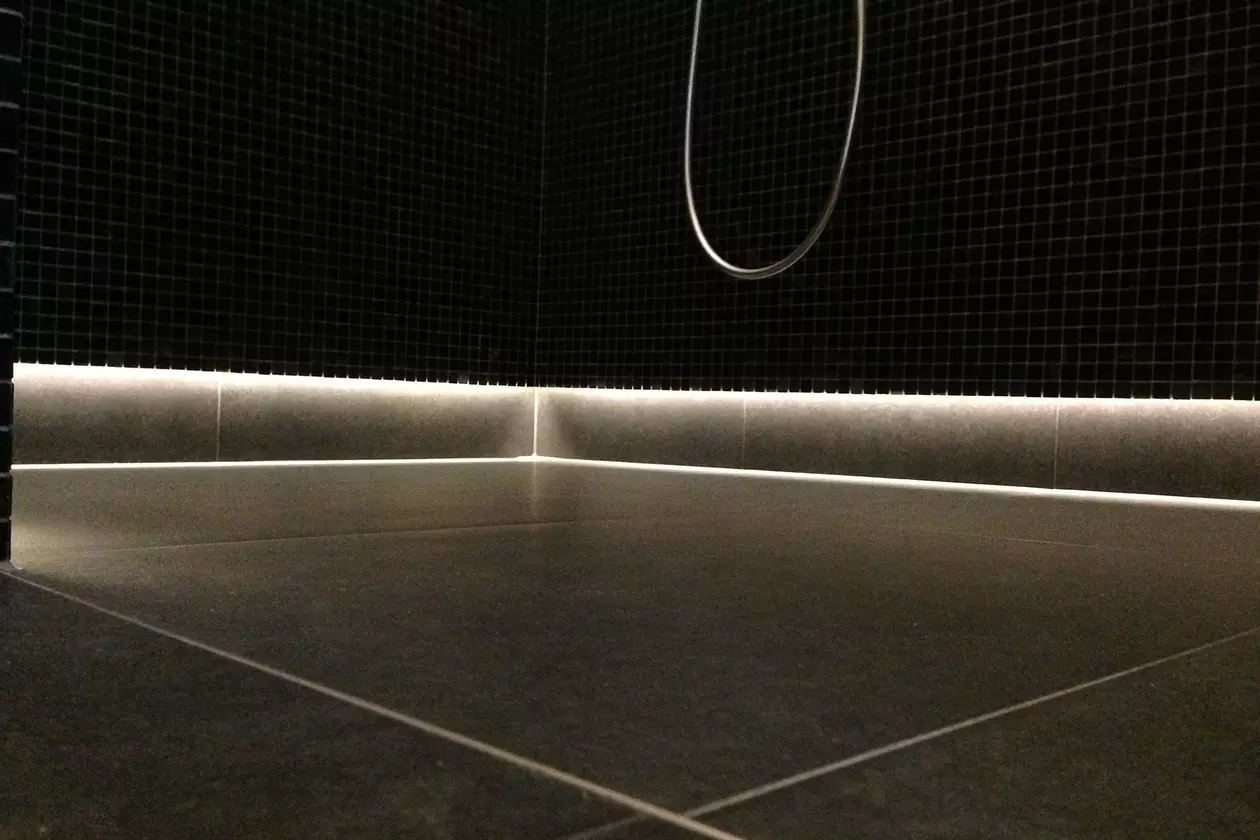
The floor area of a dark tiled shower with a recessed light strip along the skirting © Schlueter-Systems

Something that has become a popular design element in galleries, furnishings and bar areas for quite some time is now also becoming even more popular in showers and around bathtubs: Lighting profiles at the transition between the floor and the wall, installed around the outside and in combination with a recessed skirting. The resulting floating effects are ideal for achieving atmospheric, low-glare lighting, in colours that can be adjusted to suit personal preferences. The installation of illuminated skirting profiles is also possible, provided they meet the necessary IP protection rating.

Reference projects

Light should adjust to your biorhythm – not the other way round

One of the most important aspects of effective shower lighting has less to do with design than with biology: the colour of the light, measured in Kelvin (K), influences our body clock and our sense of well-being. That is especially true of the bathroom and shower that we use right after getting up in the morning and last thing before going to bed at night. Modern LED profiles such as Schlüter-LIPROTEC can be colour-controlled and adjusted to produce the right light at any time of day: from invigorating morning light (around 5,000 Kelvin) to relaxing evening light (around 3,000 Kelvin) and attractive colour accents. A cleverly illuminated shower is therefore far more than merely a technical upgrade – it is an investment in the quality of your day-to-day life.

The right light at the right time of day

Concrete-effect shower stall with a large rain shower and a long, tiled, illuminated niche © Schlueter-Systems

Neutral white shower lighting as an energy boost

Hello, good morning: Like daylight, the bright light acts as a natural wake-up signal for the body’s biological rhythms, stimulates the mind and boosts energy levels. When used as indirect lighting – such as here, where it is installed in a niche – it st…

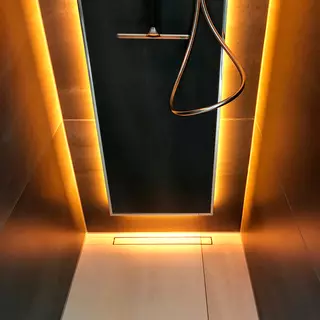
Shower backsplash with a wall panel that is backlit with warm, orange light © Schlueter-Systems

Warm shower lighting as an oasis of relaxation

Finally unwind after a long day: Soft lighting in warm colours can help us to relax more easily. It helps alleviate stress and encourages the release of sleep hormones.

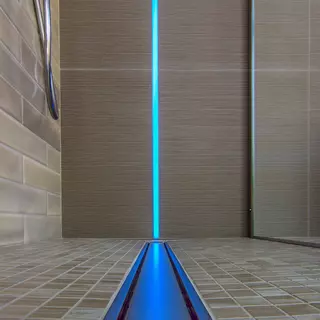
A shower with light brown tiles, a central drainage channel and a continuous blue linear light along the back wall © Schlueter-Systems

Coloured shower lighting for that spa experience

Wellness in the colour of your choice: The colour temperature of the large number of LED lamps can be adjusted to suit your mood and needs. Refreshing blues, tropical greens or relaxing shades of purple turn the shower into a personal feel-good space.

Brief explanation: Light output, light colour and colour rendering

The light output or brightness of a light fixture is measured in lumens (lm) and indicates the amount of light it emits. The higher the lumen value, the brighter the light of the lamp. As a general rule, 100 to 150 lm/m2 is sufficient for living rooms and bedrooms, whereas 250 to 300 lm/m2 is recommended for workspaces, bathrooms and kitchens.

The light colour is expressed in degrees Kelvin (K) and describes the colour temperature of a light fixture. The higher the value, the cooler and more invigorating the light colour: warm white light sources range from 2,700 to 3,000 K, neutral white from 3,300 to 5,000 K, daylight white from 5,300 K.

Colour rendering refers to how naturally a light source can reproduce colours and depends less on the colour of the light than on the spectral range of the light fixture. It is indicated by the colour rendering index (CRI) or Ra and can be a maximum of 100.