Planning walk-in showers

Floor-level, walk-in showers with a low assembly height justly deserve their popularity: They offer a high level of comfort and are designed for use by all generations. Our guide shows what you need to consider when planning a walk-in shower.

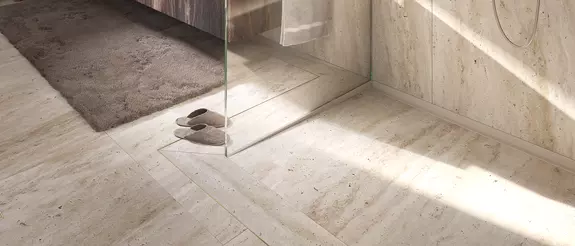
Beige tiled floor area of a level access shower with glass wall and KERDI-LINE-VARIO shower drainage channel

Step inside. Switch on the water. Enjoy the feeling of pure relaxation.

Level with the floor – and in keeping with the times: a walk-in shower, floor-level shower or Italian shower is characterised by a low entry without thresholds. Its secret to success: It combines aesthetics with comfort and functionality in all situations. Because they are often more spacious, these showers are just as suitable for a lively family life as they are for potential care situations.

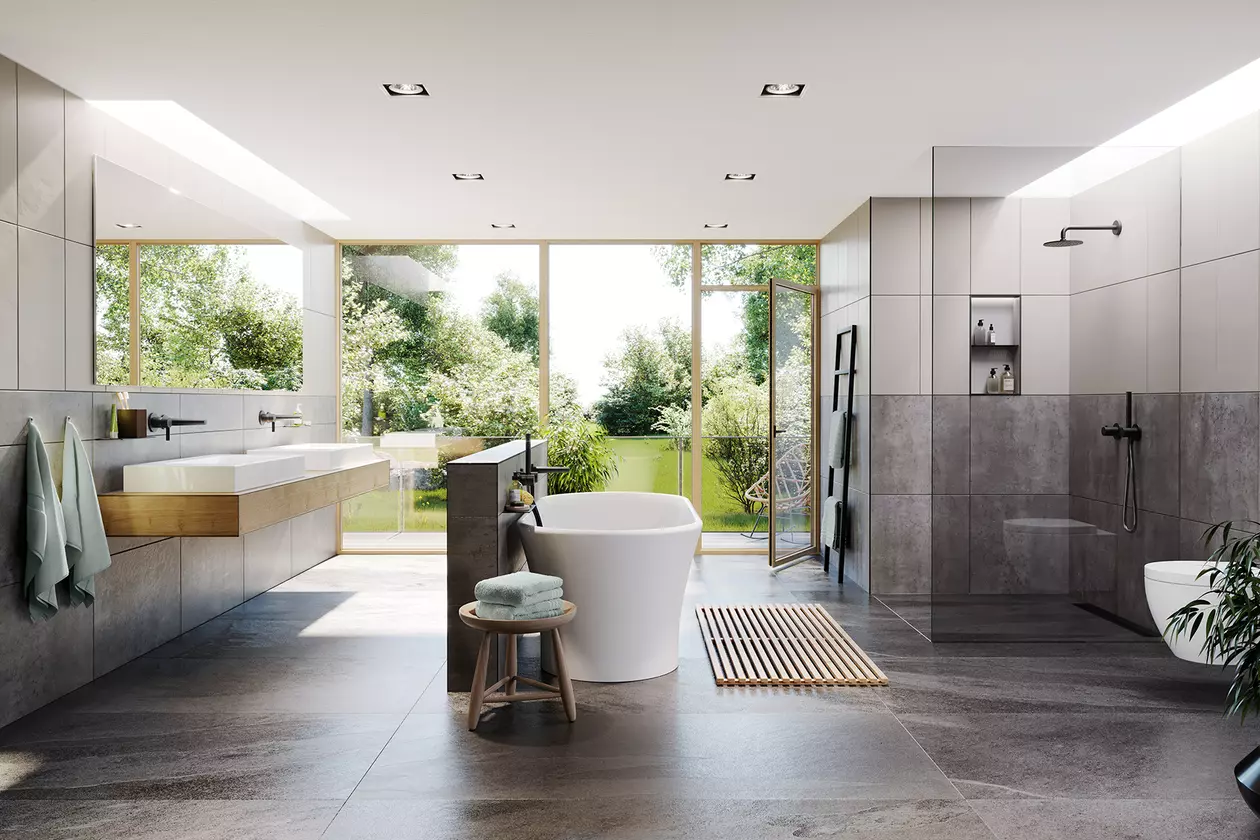
Spacious bathroom with free-standing tub in the middle, floor-level shower and double vanity unit © Schlueter-Systems

Walk-in, floor-level or barrier-free?

A generously sized shower area, an open-plan room design, elegant tiles across the entire bathroom floor: These are the images that come to mind when we think of walk-in showers. In addition to the aesthetic appeal, these showers are really comfortable to use and can be enjoyed by all generations well into the future. It is therefore no surprise that they are so popular – both in commercial and private construction projects. But bear in mind that not all walk-in showers are flush with the floor or level with the floor – and certainly not barrier-free. Although the terms are often used as if they mean the same thing, there are some small but significant differences:

Walk-in shower

  • Shower with no threshold or a very low threshold
  • An extra-flat shower tray or tiled installation substrate is customary
  • An open design, most often with nothing more than a glass wall to prevent splashing
  • Not necessarily level with the floor or barrier-free and compliant with standards

Floor-level shower

  • Shower area at the same level as the surrounding bathroom floor
  • Smooth transition without a step, edge or threshold
  • A tiled shower area is common ("Italian shower")
  • Walk-in, but not necessarily barrier-free and compliant with standards

Barrier-free shower

  • Shower that is designed in accordance with applicable regulations
  • E.g. shower area of 1.20 x 1.20 m for barrier-free or 1.50 x 1.50 m for wheelchair-accessible design required by German DIN 18040
  • A maximum bevelled height difference of 2 cm as permitted by this standard
  • Walk-in, but not necessarily at floor level or wheelchair accessible

Inspiration

Whether in a family bathroom, guest bathroom or contemporary en-suite: Walk-in showers are not intended solely for large rooms and can be adapted to different floor plans. Depending on the structural requirements, however, detailed solutions such as intelligently placed partitions are required, as an open shower requires more space than a closed one due to splashing water.

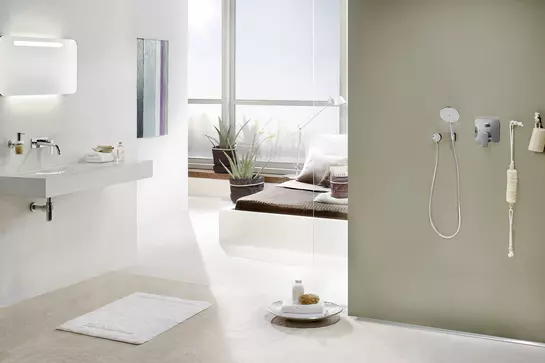
En-suite bathroom with open shower, window front and bed in the background ©Â Schlueter-Systems

En-suite

This bathroom of this apartment is connected to the bedroom by a sliding glass wall only, with the shower area completely integrated in the bathroom floor. This visually blurs the boundaries of the rooms and creates a feeling of maximum openness.

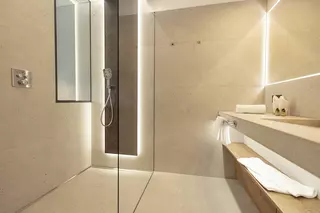
Beige tiled bathroom with walk-in shower and vanity unit with large-format mirror © Schlueter-Systems

Small bathroom

A glass wall separates the shower area from the vanity area here and, together with large-format mirrors and indirect lighting, ensures an inviting atmosphere.

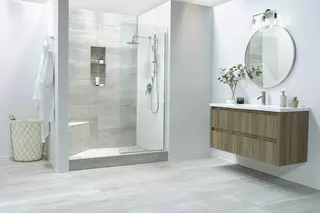
Bathroom tiled in grey marble with shower and vanity unit © Schlueter-Systems

Guest bathroom

Where floor-level showers are not technically possible, a walk-in shower is often still an option. Seating and a niche provide additional comfort here.

As well as the layout and space requirements, functional aspects must also be taken into account in an open shower. The drainage is of particular importance: It can be planned with central shower drainage or a shower drainage channel, each of which requires different floor slope situations. There are usually fewer walls available for creating storage spaces and thus fewer options. Walk-in showers are therefore predestined for the installation of niches.

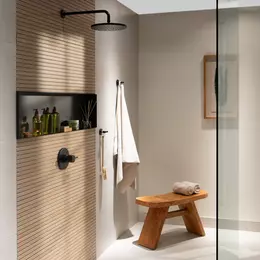
Open shower with glass wall, tiles in a wood finish and a black wall niche along the back wall © Schlueter-Systems

Stylish and clever

Wall niches such as the Schlüter-DESIGN-NICHE made of coated aluminium provide practical storage space without restricting space for movement in the shower.

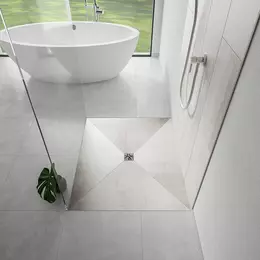
Bright bathroom with a floor-level shower, glass partition wall and freestanding bathtub © Schlueter-Systems

Timless and barrier-free

Large surface area, threshold-free entry, central drainage and accessible from two sides, this open shower is not just timeless and modern, but can also be accessed with a walker if required.

Floor-level shower with triangular profile made of brushed stainless steel along the side © Schlueter-Systems

Simple and safe

The Schlüter-SHOWERPROFILE-S acts as a triangular profile and covers the side edges that are created when installing a floor-level shower with linear drainage at the rear.

More space, more comfort – more relaxation

The advantages of a walk-in shower are immense and based primarily on its open design. They can be summarised into three main aspects:

 Comfort and safety

The absence of a threshold makes it easier to get in and out, especially for people with restricted mobility, the elderly or children. Even if the planning does not meet all the standard requirements for a barrier-free bathroom, there is usually more room for movement than in a normal shower and this is often ample space for carers or family members.

 Aesthetics and sense of space

The openness of the shower makes the bathroom appear more spacious and modern: A single glass partition wall blends in far more harmoniously than a shower cubicle – and some walk-in showers are even constructed without any side walls at all. A continuous tiled floor laid throughout the entire bathroom reinforces this impression and creates a timeless elegance that remains up-to-date even years later.

 Hygiene and care

The smooth surfaces of large-format tiles are easy to clean and the absence of thresholds makes them more accessible. At the same time, the open design ensures that the surfaces are better ventilated, so that they dry more quickly and are less susceptible to mould.

Although comfort and the feeling of space are often associated with larger bathrooms, floor-level showers can also be fitted in small bathrooms with limited floor layouts. The floor-level access is then combined with a glass door to protect the flooring, adjoining walls and sanitary fixtures from resulting water splashes. Positive side effect: In enclosed floor-level showers, water vapour and heat cannot escape directly. If steam is your thing, it is a good idea to fit your walk-in shower with partition walls to keep the steam in.

Reference projects

Proper planning is half the job – the most important technical aspects

Regardless of whether it is a shower tray or tiled floor, the installation of a floor-level shower, particularly in older buildings, requires not just careful planning but also professional execution. Particular attention has to be paid to drainage, because the shower water can only be safely drained away if there is enough space for the necessary slope. We have compiled the most important technical aspects for you below. The installation of a floor-level shower is not a project for beginners, however, and the expertise of specialist companies is indispensable in order to avoid costly mistakes during the renovation.

Assembly height

The height of the floor construction is the deciding factor for the possibility of a floor-level shower, especially in older properties. For a walk-in shower to be installed successfully, the drainage unit must first be installed in the load distribution layer. But the gradient to the connecting pipe, the gradient for the actual shower area and a standard-compliant waterproofing layer must also be taken into account. Space-creating measures such as raising the bathroom floor or removing the ceiling panel are not just costly, but also structurally relevant. A low threshold – such as a tiled shower tray – can, in this case, be the smarter and more economical alternative to a floor-level or barrier-free shower.

Drainage

To prevent the water from an open shower from spreading all over the bathroom, various requirements must be satisfied. To start with, the drain pipe must have a slope of at least 1-2% to the downpipe to ensure reliable water drainage without blockages. The shower drain itself must be large enough to handle the volumes of water produced by a powerful shower head. The shower area itself also needs to have a slope so that the water flows towards the drainage point. This can also be achieved with the KERDI-SHOWER shower boards that already have cut-outs for shower drains or shower channels. They also act as a base for installing the tile covering and form part of the secure waterproofing.

Waterproofing

Damage caused by the penetration of moisture is often extensive and expensive, which is why reliable protection of substrates and adjacent components is essential, especially in wet areas.

In Germany, the waterproofing of indoor areas is regulated by DIN 18534 and is usually implemented as bonded waterproofing on tiled surfaces. Only the combination of waterproofing material, thin-bed mortar and tiles ensures full waterproofing and must also be applied with care at transitions such as corners, niches or pipe penetrations.

In bathrooms with floor-level showers, it is also advisable to waterproof doorways so that adjacent rooms are protected from the ingress of water. We recommend purchasing all components from a single manufacturer to ensure system compatibility – like the Schlüter-KERDI waterproofing system that meets all the relevant standards, together with the Schlüter-DITRA uncoupling mat.

Equipment

On average, bathrooms are renovated fully (or to some extent at least) every 15 to 25 years – for this reason, it is important to plan your shower in such a way that it has all the special features you need in terms of space and functionality and will remain comfortable to use in the future! From fixtures and fittings to seating options, there are many different ways to increase comfort:

Costs and funding possibilities

The remodelling of a shower can be expected to cost a few thousand pounds – but depending on the scope of the construction work and the required fixtures and fittings, this figure could be significantly higher. So you should find out if there are any funding possibilities available for your specific project!