


Schlüter-DITRA-DRAIN 8 Drainage, ventilation and uncoupling membrane
One product, multiple functions: for use outdoors, Schlüter-DITRA-DRAIN 8 offers the proven DITRA uncoupling technology. It effectively neutralises tensions between the substrate and the tile or stone covering to prevent cracking at the surface. Moreover, DITRA-DRAIN 4 promotes subaeration to help with quick curing of the adhesive and drains accumulating water without pressure.
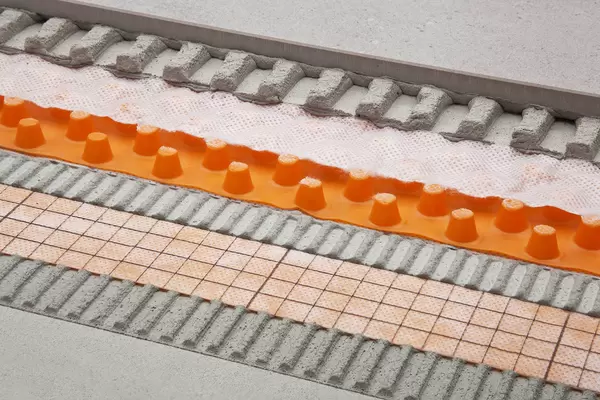
The polyethylene membrane with its stud structure has a fleece fabric to bond with the tile adhesive and a special filter webbing.
errorOops. Something went wrong!
General product information
Schlüter-DITRA-DRAIN-8 is a safe and permanently effective passive capillary bonded drainage mat.
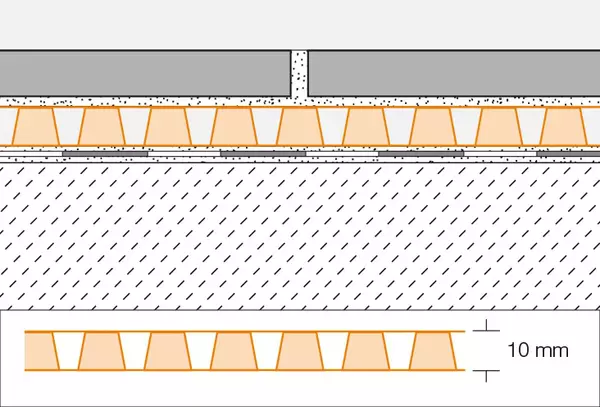
Schlüter-DITRA-DRAIN 8 consists of an impact resistant polyethylene foil with a special truncated stud structure on one side and polypropylene filter webbing laminated on both sides. The filter webbing on the underside promotes the bond of the cementitious tile adhesive, which is applied with a notched trowel (recommended: 3 x 3 mm or 4 x 4 mm) to DITRA-DRAIN 8. Completely embed DITRA-DRAIN 8 in the adhesive.
Schlüter-DITRA-DRAIN 8 was specifically developed for outdoor applications.
The closed polyethylene membranes DITRA-DRAIN 4 and 8 form an additional protective layer for bonded waterproofing.
Summary of functions
a) Drainage/ventilation
The ventilation allows for fast drying of the cementitious tile adhesive. The passive capillary drainage effect ensures that water accumulating in the drainage space flows off without pressure and prevents it from seeping back into the covering layer.
b) Uncoupling
Schlüter-DITRA-DRAIN uncouples the covering from the substrate and neutralises stresses between the substrate and the tile covering that result from various deformations. The material also bridges tension cracks from the substrate and prevents them from affecting the tile covering.
- Always check that the substrates on which DITRA-DRAIN is to be installed are level, load bearing, clean and compatible with the materials to be used. Remove all surface components that may weaken the bond. Any levelling, height adjustment or slope compensation must be carried out before placing the bonded waterproofing assembly and installing DITRA-DRAIN. The waterproofing layer must have an adequate slope for drainage.
- If using DITRA-DRAIN 4, apply a standard dry set mortar to the substrate on the previously described substrate with a notched trowel (6 x 6 mm). The recommended notching for DITRA-DRAIN 8 is 4 x 4 or 6 x 6 mm. The selection of the tile adhesive to be used with DITRA-DRAIN depends on the corresponding substrate. If using covering materials with a side length exceeding 30 cm, we recommend a water-binding tile adhesive for rapid curing and drying of the mortar.
- Embed the DITRA-DRAIN sheets, which must have been cut to size beforehand, in the applied adhesive, and immediately press them in place with a float or roller. If using DITRA-DRAIN 4, check that the inverted truncated pyramid chambers are filled with mortar after the installation. The curing time of the adhesive must be observed. For efficient installation, keep DITRA-DRAIN tightly stretched with light tension when placing it on the substrate. The individual membranes are placed with abutting joints, overlapping the lateral fleece edges.
The self-adhesive DITRA-DRAIN-STU joint tape is available for cut edges that have no fleece edge.
- To prevent any damage to the installed DITRA-DRAIN mat or detachment from the substrate, it is recommended to protect the area, e.g. by setting out running boards (particularly in the centre areas used for material transport).
Special protective measures may be necessary for outdoor installations, e.g. to shield against direct sunlight or precipitation.
- Tiles or natural stone coverings can be installed immediately after adhering the DITRA-DRAIN mat, using the thin-bed method. All coverings must be solidly embedded in the adhesive.
The notch size of the trowel must match the tile format. Observe the curing time of the adhesive. In outdoor areas, the dry-setting thin-bed mortar and the coverings must be waterproof and weather resistant.
- The covering can be grouted with a suitable material once it is ready to bear weight.
- In outside areas, the open drainage space in the edge area must be covered with a profile such as Schlüter-BARA-RT or an anchoring panel without fully closing the drainage joint.
- Follow the instructions given here and in other relevant technical regulations to install movement joints for perimeter, edge and transition profiles.
Note:
We recommend our profile types Schlüter-BARA and -DILEX for edging profiles, movement joints and floor-wall transitions.
Areas of application/substrates for Schlüter-DITRA-DRAIN
General
Always check the substrates on which DITRA-DRAIN is to be installed to make sure they are level, rigid, load-bearing, clean and compatible with the materials to be used. Remove all surface components that may weaken the bond. Any levelling, height adjustment or slope compensation must be carried out before installing DITRA-DRAIN.
Interior
Assemblies in interior spaces should only be constructed with DITRA-DRAIN 4 and not with DITRA-DRAIN 8.
Cement screeds
In accordance with the applicable regulations, cement screeds must have cured for a minimum of 28 days prior to tile installation and have a moisture content below 2 CM %. Floating and heated screeds have a particular tendency to buckle and crack even later, e.g. due to mechanical stresses and temperature fluctuations.
With DITRA-DRAIN 4, tiles can be installed on freshly installed cement screens as soon as they are ready to bear weight.
DITRA-DRAIN 4 will neutralise cracks and screed deformations developing later and will prevent them from affecting the tile covering.
Gypsum based screeds
According to the applicable regulations, calcium sulphate screeds (anhydrite) may not have a residual moisture level of more than 0.5 CM % at the time of tile installation. In contrast, tile installation is permissible from a residual moisture level of 2 CM % with DITRA-DRAIN 4.
If necessary, the screed surface must be treated (sanding, priming) as specified by the applicable technical regulations and manufacturer instructions. DITRA-DRAIN 4 can be installed with dry-setting or other suitable thin-bed tile adhesives. DITRA-DRAIN 4 protects the screed surface against permeating moisture. Because gypsum based screeds are susceptible to moisture, screeds must be protected against humidity, e.g. moisture seepage on the underside.
Heated screeds
DITRA-DRAIN 4 can be used on heated screeds, provided the above notes (cement, gypsum based screeds) are followed. Covering assemblies created with DITRA-DRAIN 4 are ready for heating only 7 days after completion. Starting from a temperature of 25 degrees C, the supply temperature can be increased by no more than 5 degrees C a day to a maximum of 40 degrees C.
Note:
For water-based floor heating systems, please refer to our ceramic thermal comfort floor system Schlüter-BEKOTEC-THERM.
Schlüter-DITRA-HEAT was developed specifically as an uncoupling mat designed to attach the matching system heating cables for electric floor/wall heating systems; see product data sheet 6.4.
Dry screeds
After the proper installation of dry screed elements according to manufacturer instructions, any tile format may be chosen for installation with DITRA-DRAIN 4.
Vinyl coverings and coatings
All surfaces must be load bearing and pre-treated or suitable for bonding with an appropriate adhesive, in which the DITRA-DRAIN 4 anchoring fleece can be embedded. The compatibility of the adhesive with the substrate and with DITRA-DRAIN 4 must be verified in advance.
Plywood, chipboard and compressed wood panels
These materials undergo significant deformation based on the influence of moisture (or fluctuations in humidity). It is therefore recommended to use plywood, chipboard and compressed wood panels with special water-repellent treatment to protect against moisture. However, they have to be thick enough to be sufficiently stable in conjunction with a suitable support assembly. The structure should be fastened with closely spaced screws. All seams should either have a tongue and groove connection or covered with adhesive. Edge joints of about 10 mm have to be maintained at the transition to adjoining building structures. Schlüter-DITRA-DRAIN 4 neutralises any stresses with the tile covering and also prevents permeating moisture.
Hardwood floors
In principle, ceramic coverings can be installed on sufficiently weight bearing hardwood floors with tongue and groove connections. The wooden substrate should have balanced moisture levels before DITRA-DRAIN 4 can be installed. It has proven beneficial to install an additional layer of chipboard or compressed wood panels. Uneven floors must be levelled with appropriate measures before the installation.
Flooring grade asphalt (bitumen) screeds
Schlüter-DITRA-DRAIN 4 enables the installation of ceramic coverings over weight bearing, unheated mastic asphalt screeds in indoor areas, provided they were installed in compliance with the relevant standards. Surfaces must be sanded and allow for sufficient bonding of the thin-bed tile adhesive with DITRA-DRAIN 4.
Exterior
In outdoor areas, DITRA-DRAIN 8 is especially suitable for stairs and larger balcony and terrace areas with longer drainage paths. DITRA-DRAIN 4 is suitable for drainage paths or sloped areas up to 3 m.
If the substrate does not require any waterproofing, e.g. on a drainage screed or a structure built directly over soil, DITRA-DRAIN with its functions drainage/subaeration and uncoupling can also be directly adhered to the substrate with thin-bed mortar.
Balconies / terraces
As an uncoupling and drainage mat, Schlüter-DITRA-DRAIN neutralises the tensions between the substrate and tile covering that can be caused on balconies by frequent, significant temperature fluctuations. In addition, DITRA-DRAIN protects the bonded waterproofing assembly and enables quick curing of thin-bed tile adhesive with subaeration. The bonded waterproofing assembly – such as Schlüter-KERDI 200 (see product data sheet 8.1) – must have a sufficient slope of 1.5 to 2%.
If previous coverings are sufficiently weight bearing and have the necessary slope, the existing assembly may be used as the substrate in renovation projects. Otherwise, loose or insufficiently bonded parts must be removed prior to installing the bonded waterproofing assembly and any flaws or inadequate slope must be corrected with a suitable ready-mix mortar.
Stairs
As an uncoupling and drainage mat, DITRA-DRAIN 8 is especially suitable for stairs in outdoor areas for stress relief between the substrate and the tile covering and for channeling any accumulating water in the drainage area. In addition, DITRA-DRAIN 8 protects the bonded waterproofing assembly KERDI 200 (see product data sheet 8.1) and enables quick curing of thin-bed tile adhesive with subaeration. The bonded waterproofing assembly must have a sufficient slope in the area of the steps.
Make sure that DITRA-DRAIN 8 adhered to the riser does not protrude over the surface of the step to completely channel away any accumulating water. Cover the joints with the joint tape DITRA-DRAIN-STU. At the bottom of the stairs, the drainage water from DITRA-DRAIN 8 must be able to run into a drainage space or be channelled into a drainage system. In the exposed edge area of the stairs, a 5 cm strip of 9 mm Schlüter-KERDI-BOARD (see product data sheet 12.1) can be installed in the drainage area, and a tile strip can be placed on the covering with Schlüter-KERDI-COLL-L (see product data sheet 8.4) as a water barrier or splashguard.
We recommend the use of adequate stair nosing profiles (such as Schlüter-TREP-E) for edge protection of thinner coverings and to improve anti-slip properties.
Roof terraces
Roof terraces situated above residential/commercial spaces and other areas as well as the roof spaces must first be installed as a flat roof in accordance with the applicable building regulations for roof assemblies.
In case of heat-insulated residential or commercial spaces (and rooms with anticipated temperature differences to the outdoor space), a standard-compliant vapour barrier and top waterproofing layer are required. The provisions of any applicable national standards and/or relevant codes must be observed. A drainage mat (such as Schlüter-TROBA or Schlüter-TROBA-PLUS) must be installed over the top waterproofing assembly (see product data sheet 7.1 or 7.2). This is topped with a screed as the load distribution layer. DITRA-DRAIN is installed on the screed surface to uncouple and ventilate the tile covering and to protect the screed from moisture. As an uncoupling mat, Schlüter-DITRA-DRAIN neutralises the tensions between the substrate and tile covering that can be caused on terraces by frequent, significant temperature fluctuations.
Schlüter-DITRA-DRAIN 8 consists of a dimensionally stable polyethylene sheet with truncated conical studs on one side and a polypropylene filter fabric laminated on both sides.
The material of DITRA-DRAIN is dimensionally stable up to a temperature range of -40 C to + +80°C. Its functional and material characteristics are permanently guaranteed. The material is resistant to ageing and non-rotting. Cutting waste is non-hazardous. Polyethylene is not UV-stable in the long term; the product should not be stored in places with prolonged exposure to direct sunlight.
The cementitious tile adhesive and the covering material used in conjunction with DITRA-DRAIN must be suitable for the respective application area and meet the applicable requirements. In outdoor areas, these materials must be waterproof, frost-proof and weather resistant.
Natural stone and concrete blocks may show discoloration due to different rates of drying.
This covering-specific occurrence cannot be completely ruled out, even if the structural assembly method described in this product data sheet is followed.
We recommend pointing this out to the homeowner when selecting the top covering.
It also must be taken into account that this assembly creates an air layer between the covering and the substrate, which reduces the contact between them. The coverings must be selected appropriately to withstand the anticipated compressive stress. The impact of hard objects must be generally avoided on ceramic coverings. For residential areas and moderate commercial use, tiles should have a minimum size of 5 x 5 cm and a minimum thickness of 5 mm for DITRA-DRAIN 4. In the case of DITRA-DRAIN 8, the minimum tile format is 5 x 5 cm, with a minimum thickness of 8 mm.
Depending on the system, stepping on coverings installed over DITRA-DRAIN with hard shoes or tapping them with a hard object may produce a hollow sound.
Microfine cracks in the joint pattern, which are caused by differences in the expansion coefficient of covering and grout material, cannot be completely ruled out.
The use of quick-curing cementitious tile adhesives that are resistant to weather and frost may be an advantage for certain projects.
Notes on movement joints
Separate Schlüter-DITRA-DRAIN above existing movement joints. Arrange the movement joints in the tile covering as specified by the applicable standards. The dimensions of such sections should not exceed a side length of 3 m in outdoor areas (balconies and terraces).
Smaller sections may be required depending on the substructure and the anticipated temperature fluctuations. In case of connections to upright building structures or wall, tensions must be ruled out by building adequate edge joints. Edge joints and connection joints must be constructed according to the applicable technical regulations and have sufficient dimensions to prevent stress build-up. We recommend using the various profiles of the Schlüter-DILEX family for building movement joints and edge joints.


Watch
Videos
Fixer Tips: Schlüter-DITRA-DRAIN for Balconies and Terraces